The Signal · Biweekly No. 001 Filed · Monday, April 23, 2026
The skilful general establishes himself on a position which makes defeat impossible.
— Sun Tzu, The Art of War, IV.16
Curation isn’t simplification. It’s direct sales—repackaged as programmatic—and it shifts control of the auction to the platform.
On Monday morning in El Segundo, the head of programmatic monetization at a mid-tier FAST publisher opened the Roku Curate documentation and read it twice.
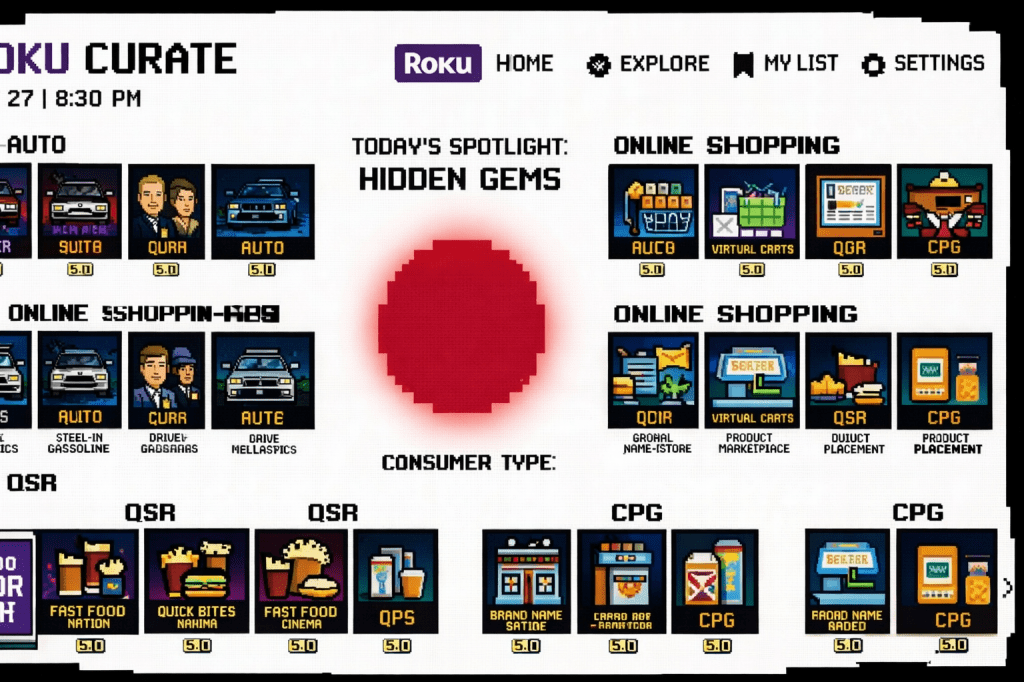
Curate combines:
- Roku’s first-party viewing data
- purchase signals from Best Buy Ads, Criteo, Fandango, Fetch, Instacart, and Kroger Precision Marketing
- premium FAST and AVOD inventory
- Magnite’s SpringServe ad server
- the Roku Exchange auction
- closed-loop measurement tied to retailer IDs
The buyer transacts all of it as one object: data, inventory, execution, and measurement.
Her own deals into the same inventory pool would now be priced against that object.
She closed the deck and pulled the last quarter of fill-rate logs on Roku-sourced demand. The numbers had been drifting. Now there was a name for the pattern.
The trade press called the launch simplification.
From her desk, it looked like the buyer’s choice being narrowed.
Curation is direct sales wearing programmatic clothes.
The curator—not the buyer or the seller—holds the position.
The pattern is older than ad tech.
Markets often begin open: many participants, loosely coordinated, with pricing emerging from interaction. Over time, the function that organizes the market—matching, bundling, settlement—consolidates. When that happens, power moves to whoever sets the table.
That shift rarely looks like control. It looks like order.
Curate collapses six separable decisions into one transaction.
In the previous model, a buyer chose:
- which data to use
- which inventory to access
- which exchange to transact on
- which measurement to trust
Each step introduced competition. Each component could be priced against alternatives.
In Curate, the choice is made once—at the package level.
After that, the platform decides what wins the impression.
The substrate is Roku.
The curator’s position rests on asymmetric visibility.
Roku sees:
- the device and household
- app usage and content codes
- the bid stream and floor prices
- and now, purchase outcomes
No counterparty inside the package sees all of these signals at the same time. No counterparty outside the package sees them at all.
Position in any market is a function of what only the position-holder can see. Visibility compounds.
A buyer who accepts the package accepts the curator’s view of the auction as the auction itself.
For mid-tier publishers selling outside Curate, the consequence is pricing geometry.
Curated demand arrives first, with priority access to the inventory pool Roku assembles. Uncurated demand arrives later—and at a markdown that reflects the curator’s already-claimed margin.
Large players can absorb this.
A company with strong first-party data and direct relationships can offset the loss at scale. A FAST channel monetizing through a third-party SSP cannot. The loss shows up directly in yield.
Programmatic once leveled the field.
Curation is that leveling being reversed—by the party that already controlled the gateway.
On the buy side, the shift is symmetric.
The Trade Desk launched Koa Agents with Stagwell as an alpha partner, automating planning and inventory selection. Magnite shipped a seller agent shortly after. The IAB Tech Lab’s Ad Context Protocol (AdCP) includes a Curation Protocol scheduled for Q2 2026.
These systems decide how curation is defined and negotiated in agent-to-agent markets.
Whoever defines the protocol defines whose curation gets honored.
The buyer’s bot will speak the curator’s language.
Coverage focuses on the package because the package is what was announced.
The position is what was built.
Roku, with roughly twenty-eight percent of U.S. CTV gateway share, is converting gateway position into transactional position. Samsung Tizen and LG webOS are building equivalent structures. Vizio, now owned by Walmart, already has the retail loop attached at the OS layer.
Each curated package creates a private auction inside a public one.
The buyer who measures only outcomes will accept what the package returns.
The leverage the open exchange once provided does not survive the package.
Keys
1. Read what the package conceals as carefully as what it reveals.
Bundling hides pricing. Data, inventory, and execution are no longer separately priced. Demand a component-level view—even if it’s not offered.
2. Watch where the curator’s data does not reach.
Curate reflects the households inside its retail data perimeter. Outside that perimeter, performance reverts to average. Diagnose by audience, not line item.
3. The mid-tier window is closing.
Publishers selling into curator-controlled pools will face structural pressure within 12–18 months. The options are limited: build a counter-package, embed within another curator, or move into demand the curator cannot reach.
4. The seller agent is not optional.
As buyer agents scale, negotiating without automation introduces structural latency. The disadvantage compounds.
5. The protocol is the position.
Standards like the IAB’s Curation Protocol will define how value is described and transacted. Influence the schema, or inherit it.
Reversal
The position is powerful, but not absolute.
Every curator operates within a data perimeter—and every perimeter has edges.
Roku sees its viewing graph and retail partners. Walmart-Vizio extends into commerce. Amazon reaches further, but still leaves gaps—in mobility, in offline behavior beyond its network, and outside its geography.
A publisher with meaningful first-party data—a subscription base, ticketing, or retail linkage—can build a counter-position by pricing against those blind spots.
The attack is expensive. It is not impossible.
Curators also compete on efficiency. Some will under-extract rent to gain share. That accelerates adoption while deepening dependence.
The question is not whether to use curated packages.
It is what you give up when the terms reset—and whether you know which line will move before it does.
Closing
Programmatic was supposed to return power to the auction.
Fifteen years later, the negotiator is back—inside the auction—operating on both sides of the table.
Treating curation as a procurement decision misses the mechanism.
It is a position.
And it belongs to the party that sets the table.
Filed from inside the auction. The Signal ✦ By Albert · ElementalTV
 theSIGNAL.tv
Leave a comment